
If you are facing federal child pornography charges in Philadelphia, sentencing statistics can be difficult to read without imagining that the numbers predict what will happen to you.
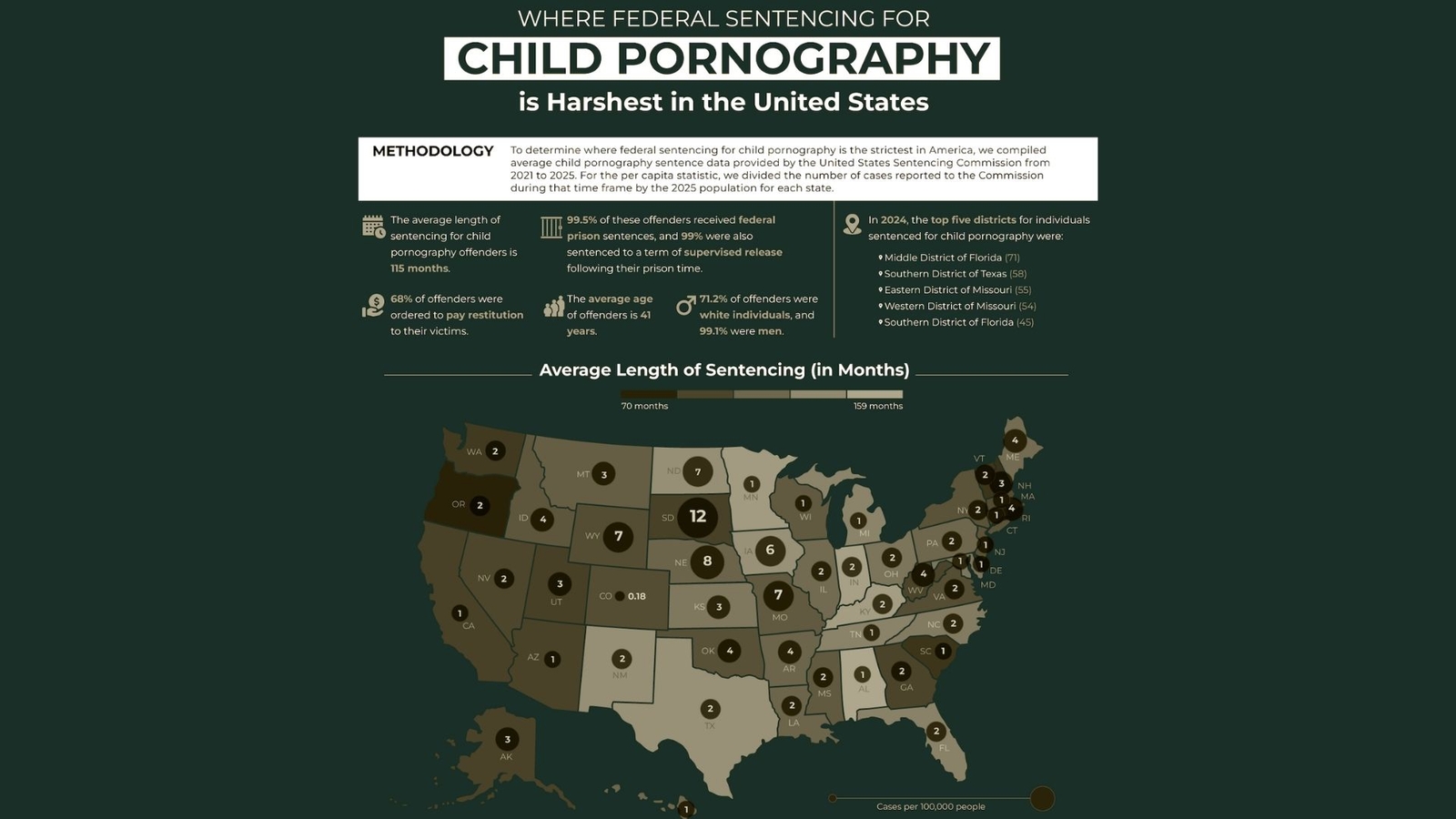
The Eastern District of Pennsylvania, which includes Philadelphia, had an average reported prison sentence of 145 months and a median of 120 months across the 70 cases included in a Brennan Law Offices study of federal sentencing data from 2021 through 2025.
By comparison, the study found an average prison sentence of 114 months across Pennsylvania from 2021 through 2025. For national context, the U.S. Sentencing Commission reported an average sentence of 115 months in fiscal year 2024 for the non-production child pornography offenses included in its §2G2.2 data.
Those figures provide important historical context, but they do not predict the sentence in an individual Philadelphia case. They do not tell you whether the government can prove the charge, whether the case would result in a conviction, or which statutory and sentencing considerations would apply to you.
To evaluate your potential exposure, we must look beyond the averages and examine the charge, the evidence, the applicable statutes, the Sentencing Guidelines, and the facts specific to your case.
What Does the Study Show About Federal Sentencing in the Eastern District?
Our study compared reported federal sentencing outcomes nationwide and across Pennsylvania’s three federal judicial districts. Within Pennsylvania, the Eastern and Middle Districts had median sentences of 120 months, while the Western District had a median of 78 months. The average sentences were 145 months in the Eastern District, 132 months in the Middle District, and 88 months in the Western District.
For national context, the U.S. Sentencing Commission’s fiscal year 2024 data reported an average sentence of 115 months, with 99.5% of individuals sentenced for these offenses receiving prison sentences.
The sentencing data concern non-production child pornography offenses included in the U.S. Sentencing Commission’s §2G2.2 category. They should not be read as sentencing data for production offenses governed by §2G2.1.
These findings illustrate the seriousness of sentencing in these federal cases, but they describe outcomes across groups of completed cases. They do not establish a standard Philadelphia sentence or explain all the factual and legal differences behind those outcomes.
Why the Average Does Not Predict the Sentence in Your Case
An average is calculated by adding the reported sentences and dividing that total by the number of cases. A small number of unusually lengthy sentences can raise the average.
The median represents the middle result when sentences are placed in order. Although that measurement is less affected by extreme results, it still does not describe every person’s case.
Neither figure tells you:
- The offense of conviction: Which federal offense or offenses resulted in the sentence
- The statutory range: Whether a mandatory minimum or enhanced statutory range applied
- The conduct considered: What was admitted, proved at trial, or found by the court for sentencing purposes
- The Guidelines calculation: Which provisions, adjustments, or cross-references were applied, disputed, or rejected
- How the case concluded: Whether the conviction followed a guilty plea or trial
- The relationship to the Guidelines: Whether the sentence fell within, above, or below the advisory range
- The individual circumstances: What personal history, records, treatment, rehabilitation, family circumstances, or other mitigating information the court considered
For that reason, the Eastern District’s 145-month average should not be treated as an estimate of the sentence you would receive in a Philadelphia case. A meaningful sentencing analysis must begin with the specific federal criminal charge involved.
Why the Specific Federal Charge Changes the Sentencing Analysis
“Child pornography charge” is a broad description rather than a single federal offense, and these allegations fall within a broader category of sex crime charges that can involve different statutes, evidence, and potential penalties. Federal criminal statutes use the term “child pornography,” while the Sentencing Guidelines refer to material involving the sexual exploitation of a minor. Child sexual abuse material, or CSAM, is also commonly used to describe the underlying material.
A prosecution could involve allegations of possession, receipt, transportation, distribution, advertising, or production. Different offenses can carry different maximum penalties, and some carry mandatory minimum prison terms.
The statutory ranges illustrate that difference. Certain receipt and distribution offenses under 18 U.S.C. § 2252A carry a mandatory minimum of five years and a maximum of 20 years in prison. A qualifying prior conviction can increase that range to 15 to 40 years.
Possession under 18 U.S.C. § 2252A(a)(5) is subject to a different penalty provision and ordinarily does not carry the five-year mandatory minimum that applies to certain receipt and distribution offenses. The statutory maximum is generally 10 years, although it increases to 20 years if an image involved a prepubescent minor or a minor under 12. A qualifying prior conviction can result in a mandatory minimum of 10 years and a maximum of 20 years.
This distinction matters.
Two cases described generally as child pornography prosecutions can involve substantially different sentencing exposure because they concern different offenses, alleged conduct, prior convictions, or statutory provisions. Before relying on a sentencing statistic, we need to know precisely what offense is charged, what the government would have to prove, and which statutory penalties could apply.
Even then, the statutory range is only one part of the federal sentencing analysis.
How the Federal Sentencing Guidelines Affect Your Exposure
After a federal conviction, the court calculates an advisory sentencing range under the United States Sentencing Guidelines.
For many federal non-production child pornography offenses, Guideline §2G2.2 generally provides the applicable offense guideline. The calculation begins with a base offense level. The court then determines whether specific offense characteristics, reductions, or other adjustments apply. At sentencing, the court calculates the criminal-history category separately and uses it with the offense level to identify the advisory range.
Depending on the case, disputes can concern alleged distribution, computer use, the number or characteristics of the images, an alleged pattern of activity involving the sexual abuse or exploitation of a minor, and whether a different guideline or cross-reference applies. Other parts of the Guidelines calculation can involve acceptance of responsibility, obstruction, and the grouping of multiple counts.
The advisory guideline range can be highly influential, but it does not automatically determine the final sentence. The court must also consider the statutory sentencing factors and explain the sentence it imposes.
That is one reason a district-wide average cannot replace an individualized guideline analysis.
What the Differences Among Pennsylvania’s Federal Districts Can Show
The differences among Pennsylvania’s federal districts are notable, but the study does not establish why the reported averages varied.
The study does not separately identify the mix of offenses, applicable mandatory minimums, criminal histories, guideline calculations, plea outcomes, or other case characteristics within each district. Any of those differences could affect a district-wide average.
The comparison also involves different numbers of cases. The Eastern District figure was based on 70 cases, while the Western District figure was based on 115.
The data therefore support a careful conclusion: reported sentencing outcomes varied substantially among Pennsylvania’s federal districts. The study does not prove that geography alone caused those differences or that judges in the Eastern District of Pennsylvania impose one customary sentence in every case.
What a Federal Judge Considers at Sentencing
Under 18 U.S.C. § 3553(a), the court considers the nature and circumstances of the offense and your history and characteristics. It also considers the need for the sentence to reflect the seriousness of the offense, provide just punishment, deter criminal conduct, and protect the public.
Other considerations include needed treatment or correctional services, the advisory guideline range, the need to avoid unwarranted sentencing disparities, and restitution. The court must impose a sentence that is sufficient, but not greater than necessary, to serve the statutory purposes of sentencing.
The judge can also consider the presentence investigation report, objections from the parties, sentencing memoranda, supporting records, statements made at the hearing, and properly presented mitigating circumstances.
Employment history, treatment records, medical conditions, family circumstances, rehabilitation, and other background information can also be relevant. The weight a judge gives that information varies, and no single factor guarantees a particular result. Because information relevant to sentencing can take time to identify, document, and evaluate, these issues can require attention earlier in the case.
Why Sentencing Exposure Can Matter Before a Plea or Trial
At Brennan Law Offices, we do not begin by assuming that your case will result in a conviction or sentencing. We first examine whether the government can prove its allegations. At the same time, understanding the possible sentencing exposure can help inform decisions made during an investigation, charging discussions, plea negotiations, and preparation for trial.
Statements made to agents, forensic findings, the charges ultimately filed, and disputes over relevant conduct can affect the factual and guideline issues that arise if the case later reaches sentencing.
We review search warrants, digital evidence, account-access records, device-ownership evidence, statements, and available forensic findings. That review can help us evaluate who allegedly used or controlled an account or device, what the evidence shows about intent, and whether the government can prove each element of the charged offense.
If your case does proceed toward sentencing, we would carefully review the presentence report, identify factual or guideline disputes, develop relevant mitigation, and present a sentencing position grounded in the complete record and your individual circumstances.
What the Sentencing Data Means for Your Case
The Brennan Law Offices study provides important context about historical sentencing patterns, including substantial differences in the average sentences reported among Pennsylvania’s three federal districts. The data show why the potential consequences deserve careful attention, but they cannot predict the outcome of an individual case.
The data cannot tell you whether the government can prove its allegations, which statutory penalties would apply, how the Guidelines would be calculated, or what sentence a judge would impose. Answering those questions requires a review of the specific charge, the evidence, the applicable law, and your individual circumstances.
If you are under investigation or facing federal child pornography charges in Philadelphia, we can review the allegations, the government’s evidence, potential defenses, and the statutory and sentencing issues relevant to your case. To schedule a confidential consultation with a Philadelphia criminal defense attorney, contact Brennan Law Offices.
Disclaimer: This article is provided for general informational purposes and does not constitute legal advice. Past sentencing data does not predict the outcome of any individual case. If you are seeking legal advice, please contact our law firm directly.