

When prosecutors discover that the evidence no longer supports a criminal charge, should they continue simply because the government has already committed publicly to the case?
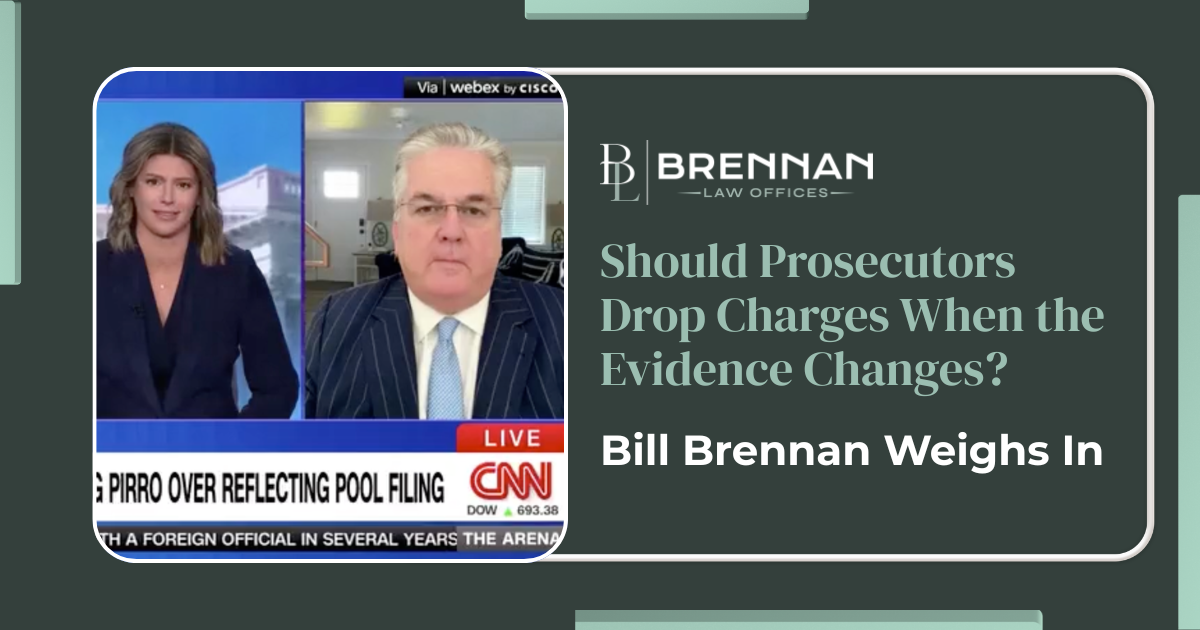
William Brennan addressed that question during two recent appearances on CNN’s The Arena with Kasie Hunt. Discussing the government’s decision to seek dismissal of a high-profile property-damage case in Washington, D.C., Brennan called the development “a great day for justice.”
His point was direct. A prosecutor’s responsibility is not to defend a charge at all costs. It is to follow the evidence, even when doing so requires acknowledging that the case should not continue.
That principle matters far beyond one high-profile prosecution. If you have been arrested, indicted, or publicly accused, it can feel as though the government’s initial conclusion has already decided your future. It has not. Prosecutors are expected to continue evaluating the strength and reliability of the evidence, and the defense has the right to challenge the assumptions behind the charge.
Why Prosecutors Reconsidered the Reflecting Pool Charge
Prosecutors accused former Olympic canoeist David Hearn of intentionally damaging material lining the Lincoln Memorial Reflecting Pool. A grand jury indicted him in the Superior Court of the District of Columbia on a felony property-destruction charge.
After the indictment, the U.S. Attorney’s Office received additional information about the pool’s renovation. According to the government’s motion to dismiss, the lining was peeling and separating in numerous areas because of installation problems, undermining the government’s original vandalism theory.
The government also reported that a later inspection revealed peeling in areas where intentional damage appeared unlikely. Based on the newly obtained records and inspection findings, prosecutors concluded that they could no longer reasonably attribute the widespread damage to vandalism or expect to prove the charged offense beyond a reasonable doubt.
The U.S. Attorney’s Office moved to dismiss the indictment without prejudice, which would leave open the possibility that prosecutors could bring the charge again. Hearn’s attorneys have asked the court to dismiss the case with prejudice, which would prevent prosecutors from refiling the same charge based on the alleged incident.
Bill Brennan praised prosecutors for reassessing the evidence rather than forcing Hearn toward trial simply because the government had already obtained an indictment.
Filing a Charge Does Not End a Prosecutor’s Responsibility
Bringing a charge does not end a prosecutor’s responsibility to evaluate the case fairly. As new information emerges, prosecutors should reassess whether the evidence continues to support the allegation and whether admissible evidence will be sufficient to obtain and sustain a conviction.
Documents can reveal previously unknown facts. Physical evidence can support a different explanation. Witness accounts can prove incomplete or unreliable, and information held by another agency can expose weaknesses in the government’s theory.
The Department of Justice’s Principles of Federal Prosecution instruct federal prosecutors to consider whether admissible evidence will probably be sufficient to obtain and sustain a conviction. The government cited that standard in its motion to dismiss Hearn’s indictment.
The question is not whether dismissal will embarrass the government. It is whether the available evidence still supports a conviction beyond a reasonable doubt.
For someone facing charges, that distinction is critical. An indictment does not freeze a case in place. Later evidence can expose weaknesses that were not apparent when the charge was filed.
An Indictment Is an Accusation, Not a Finding of Guilt
Receiving an indictment can feel as though the government has already proved its case. It has not.
An indictment means that a grand jury found probable cause to support a criminal charge. It does not mean that a trial jury heard both sides or found the accused person guilty beyond a reasonable doubt.
Grand jury proceedings generally take place in private and are led by the prosecution. Unlike at trial, defense counsel ordinarily does not cross-examine the government’s witnesses or present a complete adversarial defense before the grand jury.
You remain presumed innocent after an indictment. The government must still prove every element of the offense with admissible evidence beyond a reasonable doubt. When later evidence weakens the prosecution’s theory, an indictment does not require prosecutors to ignore it.
A Defendant Should Not Face Trial to Protect the Government’s Position
A person should not have to endure an entire criminal trial when prosecutors have concluded that the available evidence is insufficient to justify continuing the case.
Brennan expanded on that point during his follow-up CNN appearance when he discussed a judgment of acquittal. Under D.C. Superior Court Criminal Rule 29, the defense can ask the judge to enter a judgment of acquittal after the prosecution closes its evidence if that evidence is legally insufficient to sustain a conviction. But waiting until that stage does not erase the stress, expense, and disruption that came before it.
Long before a jury reaches a verdict, a prosecution can affect where you live, whether you can travel and how you support your family. It can strain professional relationships, create financial pressure and, in a publicly reported case, place your name in damaging news coverage. You may face release conditions, mounting legal expenses and the fear that every part of your life is becoming defined by the accusation.
Waiting for a judge to end an unsupported case does not cure those harms. When prosecutors conclude that the evidence no longer supports the charge, seeking dismissal is not an act of weakness. It is an appropriate exercise of prosecutorial responsibility.
Public Pressure Does Not Lower the Burden of Proof
Once officials describe someone publicly as responsible for a crime, that account can begin to look like an established fact. News coverage spreads the allegation, agencies defend their conclusions, and the accused person can be judged before entering a courtroom.
Public certainty, however, is not proof.
Brennan praised the U.S. Attorney for exercising independent judgment when later evidence undermined the original theory. A prosecutor’s responsibility is not to protect an official statement, preserve an agency’s reputation or avoid political criticism. It is to determine whether the facts and the law support the charge.
The more publicly the government has committed to an accusation, the harder changing course can become. That is precisely when independent review of the government’s original theory matters most.
The Government’s First Explanation Is Not Always the Complete One
The Reflecting Pool case shows why that review matters. Additional evidence can reveal that an early explanation does not account for the complete factual record.
Damage initially attributed to intentional conduct was later considered alongside evidence of installation problems and widespread separation of the pool lining. That broader context weakened the prosecution’s ability to prove what caused the damage.
If you are accused of a crime, a police report, charging document, or government statement presents the prosecution’s initial account or theory of what happened. A defense lawyer should examine whether that account omits important facts or lacks necessary context.
That review includes examining what investigators knew, what evidence they did or did not obtain, whether witnesses provided complete and reliable information, and whether physical or digital evidence supports another explanation. It tests whether the accusation rests on a complete record or an early assumption.
Justice Requires Following the Evidence to the End
Bill Brennan’s comments on CNN reflected a principle that should guide every criminal prosecution: the government must follow the evidence wherever it leads. Justice is not served by forcing someone toward trial merely to protect an earlier charging decision.
If you are under investigation or facing an indictment, the government’s version of events can quickly become the official story. You still have the right to challenge that account, present evidence that changes the context, and require the prosecution to meet its burden at every stage of the case.
Brennan Law Offices represents people facing serious criminal investigations and charges in Philadelphia, throughout Pennsylvania, in select New Jersey matters, and in federal cases across the country. We move quickly, work discreetly, and build each defense around the facts of the case.
If you are under investigation or have been charged, contact Brennan Law Offices for a free, confidential initial consultation. No judgment. No agenda. Just a defense focused on what the evidence actually shows.
Disclaimer: This article is provided for informational purposes only and does not constitute legal advice or create an attorney-client relationship. Every criminal case depends on its specific facts and circumstances. Contact an attorney directly for advice about your situation.